CKN Report Presentation - Chinese Presence and Geopolitical Resilience in the Caribbean Netherlands

Political and policy attention in the Netherlands for China’s role in the Caribbean parts of the Kingdom of the Netherlands (CPKNL) has increased in recent years. Questions have emerged regarding foreign influence, critical infrastructure, economic dependency and geopolitical vulnerability in the region. Global geopolitical tensions, particularly between the United States and China, have contributed to growing concern about the strategic position of small island economies in the Caribbean basin.
This report examines the extent to which Chinese economic and political influence in the CPKNL has developed and how these development relate to the geopolitical resilience and economic security of the islands. The research is based on qualitative fieldwork, interviews and desk research conducted between January and May 2026 across Aruba, Bonaire, Curaçao and Sint Maarten.
The report distinguishes explicitly between Chinese presence and Chinese state influence. Chinese presence refers broadly to the activities of diaspora communities, private entrepreneurs, companies, diplomatic representatives and state-linked actors. Chinese state influence refers specifically to the ability of the Chinese state and affiliated actors to shape political decision-making, governance practices or strategic economic choices within the CPKNL.
Chinese presence in the CPKNL has expanded over the past decades, primarily through migration, diaspora networks and private economic activity. Chinese-owned businesses have become more visible in the local economies, particularly in retail, supermarkets, restaurants, hospitality and small-scale commerce. More recently, Chinese companies have also participated in selected infrastructure, telecommunications and renewable energy projects.
At the same time, the report finds little evidence that Chinese state-led political influence in the CPKNL has increased substantially. Chinese state-linked investments and diplomatic activities in the CPKNL appear modest compared to other Caribbean countries. Political engagement by local Chinese communities also appears limited, while the islands themselves possess relatively limited strategic value for China in formal diplomatic terms.
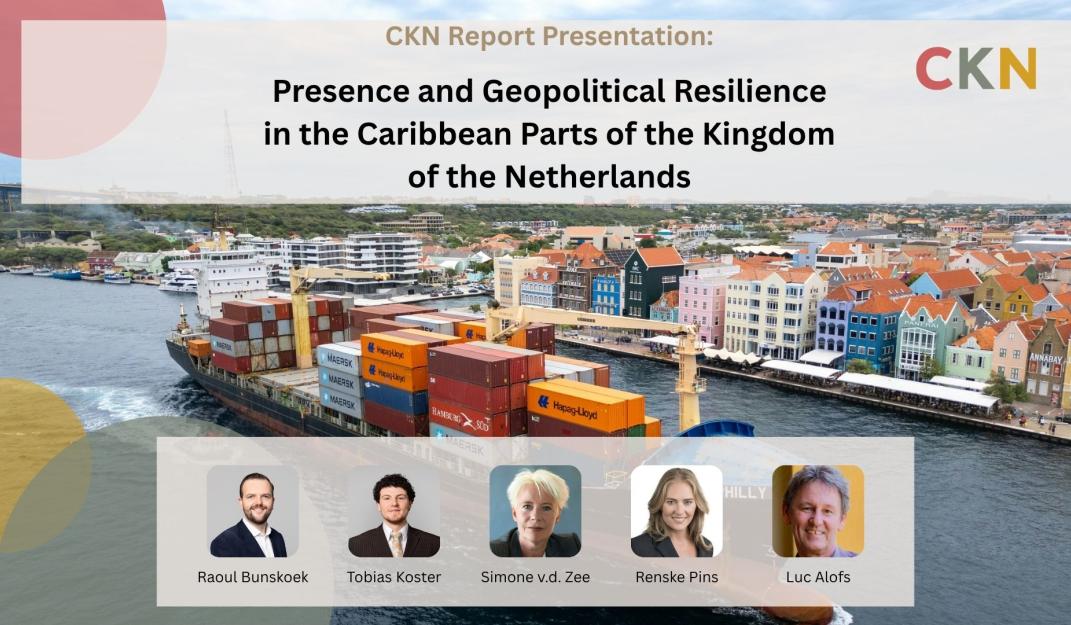
The research team - consisting of three CPKNL researchers and two Clingendael researchers - will present their findings in this CKN Report Presentation. Along with the presenters, Ellen Schepers also contributed to the creation of this report.
Practical Information
Date: Tuesday, 6 October 2026
Time: 15:30 – 17:00 CET
Venue: Room 2B.56, Spuigebouw (Spui 5, 2511 BL, The Hague) or online
Programme
15:15 - 15:30 | Arrival
15:30 - 15:40 | Welcome and introduction
15:40 - 16:10 | Presentation of key findings
16:10 - 16:55 | Q&A
16:55 - 17:00 | Closing remarks
17:00 - 18:00 | Networking drinks

China Knowledge Network
The Dutch China Knowledge Network (CKN) is a network established to involve China experts and disseminate knowledge within the government of the Netherlands and beyond.Our key task is to connect various angles of research and events to better understand China’s motives, policies and vision to develop more effective policies and better advise social partners. The secretariat of the knowledge network has been assigned to think tank Clingendael together with LeidenAsiaCentre. They will function primarily as ‘knowledge brokers’, matching the supply and demand of knowledge.